


Séminaires
376 événement(s)
Arghyadip Mukherjee (ENS Paris)
Topology and robustness in early fate decision in the fly embryo
During embryogenesis, the earliest cell fate decision is often linked to nuclear positioning, whose control arises from the integration of the cell cycle oscillator and associated cytoskeletal dynamics. Yet, the...
Alia Abbara (EPFL)
Structured populations and other stories
A classical question in population genetics is to understand the spread of a mutant with a fitness advantage in a population, in particular its fixation probability. This question has been thoroughly studied through...
Andrea Mazzolini (LPENS)
Constraining the immune system dynamics with a coevolving population: the HIV, flu and microbiome cases
The adaptive immune system is an extremely complex machinery that continuously evolves to recognize and fight external pathogens. This chase is often made harder by the fact that pathogens also evolve and try to...
Nicolas Lobato-Dauzier (Laboratoire Jean Perrin
Can we program DNA reaction-diffusion fronts with molecular motors
Couplings between biochemical and mechanical processes have a profound impact on embryonic development. However, in-vitro studies capable of quantifying these interactions have remained elusive. I will present a...
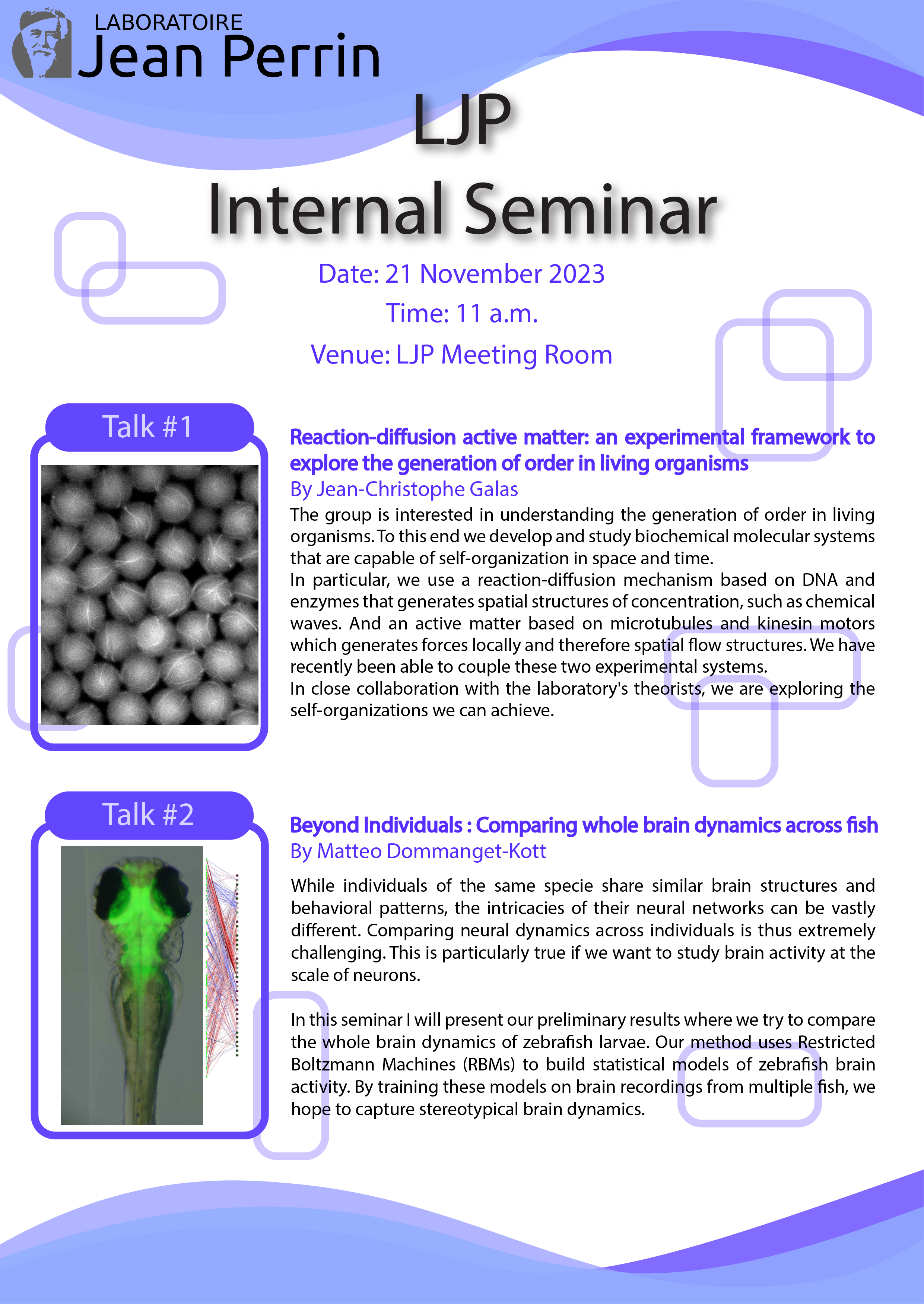
Internal Seminar: Matteo Dommanget-Kott
Internal LJP Seminar
Pierre Barrat-Charlaix (PoliTo)
Ecology of host and pathogen and limited predictability of evolution
Seasonal influenza viruses repeatedly infect humans in part because they rapidly change their antigenic properties and evade host immune responses, necessitating frequent updates of the vaccine composition. A better...
Joao Barbosa (ENS Paris)
Flexible selection of task-relevant features through population gating
Brains can gracefully weed out irrelevant stimuli to guide behavior. This feat is believed to rely on a progressive selection of task-relevant stimuli across the cortical hierarchy, but the specific across-area...