Séminaires

376 événement(s)

Nicolas DESPRAT

How does a bacterial adhesin make up its MinD?

Surface proteins are essential components of bacteria-environment interactions. Akin to their cytoplasmic counterparts, polar localization of surface proteins is required in many contexts such as cell infection or...
Pascal MARTIN

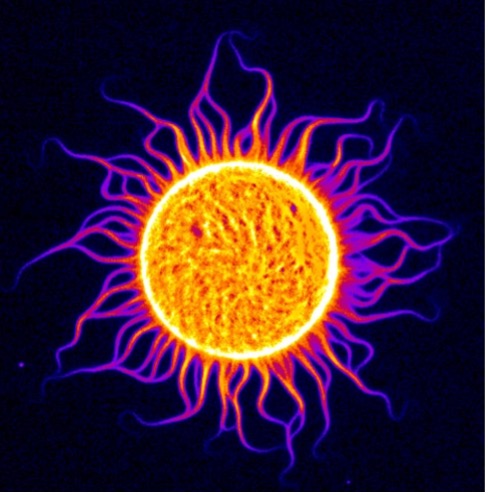
Flagella-like beating of actin bundles driven by self-organized myosin waves

Wave-like beating of eukaryotic cilia and flagella - threadlike protrusions found in many cells and microorganisms - is a classic example of spontaneous mechanical oscillations in biology. This type of self-organized...

Romain LEROUX

Séminaire interne

Active-matter droplets: patterns of an active filament by Romain Leroux Known as the cytoskeleton, networks of active biopolymers dynamically shape the cell membrane. Described by active matter physics, the...

Yann-Edwin KETA (Lorentz Institute for Theoretical Physics

Fluctuations in dense active matter and applications to epithelial cell movements

Active matter is an umbrella term which applies to a broad range of living and synthetic systems, composed of individual units each capable of consuming energy to perform motion, hence driving the system out of...

Manuel Beiran Amigo

Prediction of neural activity in connectome-constrained recurrent networks

Establishing links between the connectivity of large neural networks and their emergent function is a major goal of neuroscience. In this talk, I will explain a theory of connectome-constrained neural networks in...

Léo Régnier and Elie Wandersman

Séminaire interne.

See English version of the webpage.

Joël LEMIERE

Osmotic control of nuclear size and the N/C ratio in fission yeast

The size of the nucleus scales robustly with cell size so that the nuclear-to-cell volume ratio (N/C ratio) is typically maintained as a constant in many cell types. Previous studies show that the N/C ratio is not...